
On July 30th, a seminar on innovative exchange and discussion regarding signal production for Chinese professional football leagues, themed "Lessons from the World Cup," was held at the CFA Full-Stack AI Command Center in Beijing. The meeting focused on in-depth discussions of advanced broadcasting experiences from the 2026 USA-Canada-Mexico World Cup, domestic professional league signal production practices, and future broadcasting upgrade paths. CFA Chairman Li Kemin, Vice Chairman Yang Xu, Secretary General Shen Rui, and Secretary of the Discipline Inspection Commission Lu Xiaolan attended the meeting, along with experts and representatives from broadcasting platforms and technology service providers such as China Media Group, Migu Video, Lenovo Group, Beijing Unicom, and numerous provincial and municipal television stations across the country. The meeting was chaired by Yan Xiaomei, Deputy Secretary General of CFA, Executive Director and General Manager of CFA Corporation.
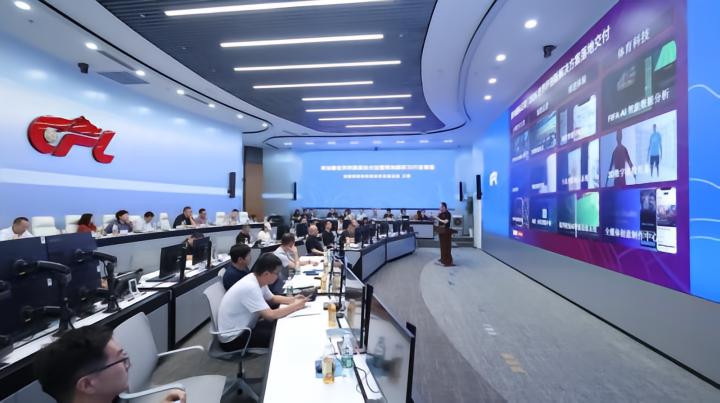
In his speech, Yang Xu, vice president of the Chinese Football Association, emphasized that the domestic professional leagues will benchmark against the World Cup broadcasting standards, accelerate the application of AI, ultra-high-definition and intelligent production and broadcasting technologies, and comprehensively improve the audiovisual broadcasting quality of the leagues.
Zhao Ruchao, producer of sports broadcasts at Jiangsu Broadcasting Corporation's Leisure Channel, explained the multi-location centralized remote production architecture and the logic of the 45-camera layout based on his experience broadcasting the World Cup. He also compared it with the existing camera configuration of the Chinese Super League and pointed out the direction for upgrading.
Zheng Zhao, Director of the Sports Events Project Department of Sony (China), provided an in-depth analysis of the iteration process of the Semi-Automatic Offside Detection System (SAOT), explained the entire process of generating rapid judgment animations, and discussed the system's implementation and adaptation in the Chinese Super League.
Wang Lei, Director of Sports Events Project at Lenovo Group, provided a complete breakdown of the World Cup's full-domain AI technology operation system, from stadium tracking cameras and 3D digital modeling of players to AI-enhanced referee perspectives and the overall dispatch and command center, resulting in a replicable digital operation solution for large-scale events.
Zhang Bin, director of the editorial department of the Sports Channel of the Sports and Youth Program Center of China Media Group, shared the logic of content planning for top global sports events from three dimensions: content layering and creation, differentiated distribution on large and small screens, and humanistic narrative expression.
In the afternoon, representatives from the invited signal production teams delivered keynote speeches on professional league signal production. Lin Xiaoqing, Director of the Live Broadcast Production Center of Migu Video, shared Migu's innovative practices in integrating AI intelligent commentary, stadium visualization, and ball trajectory tracking into the entire viewing process during the "First AI World Cup," under the theme "Let Change Shine into Chinese Football." Xue Tao, Producer of Sports Broadcasting at Beijing Radio and Television Station's Sports Channel Center, pointed out in "Illuminating Chinese Football with the Light of Broadcasting" that the "light of broadcasting" is not only the precise presentation of visual language but also the in-depth exploration and value transmission of the event's connotation. Zhang Zonghao, Director of the Sports Channel of Tianjin Radio and Television Station, spoke on the theme of "Cultural Confidence in Chinese Super League Broadcasting," believing that Chinese Super League broadcasting is a visual window carrying the spirit of the city and regional culture. Jin Yile, Secretary of the Party Branch of the Broadcasting Department of SMT, reviewed "Ten Years of Technological Iteration in the Chinese Super League and a Technological Outlook for the World Cup," systematically outlining the technological evolution of the Chinese Super League over the past ten years and looking forward to future innovation directions.
Following the keynote speeches, representatives from Chengdu Radio and Television Station, Five Star Sports, and the Football Channel, among other participating organizations, exchanged views in turn.
In her concluding remarks, Chairperson Li Kemin pointed out that this World Cup, hailed as the "First AI World Cup," has set new benchmarks for global broadcasting technology in areas such as 3D scanning, full-field tracking, smart ball control, automated refereeing, and standardized production. She emphasized that professional leagues should use this major competition to "identify gaps, clarify directions, and build consensus," promoting the deep integration of AI technology into the entire signal production process, actively promoting lightweight dissemination, accelerating the widespread application of ultra-high-definition audiovisual technology, establishing a content production system adaptable to multiple terminals, advancing the standardization and intelligent management of signal transmission, and deepening the "media asset bank" and content co-creation ecosystem.
The seminar concluded successfully. All participants unanimously agreed that this exchange would serve as a new starting point, leveraging new technologies while balancing international professional standards with local cultural expression, to create a professional league broadcasting system that combines international standards with Chinese characteristics, thereby empowering the value upgrade of the professional football industry chain through high-quality audiovisual content.